
Thursday, December 20, 2012
What Was The Co-Operative Land and Trust Company
The following news clipping provides additional details on who the ran the Co-operative Land and Trust Company and what their vision was in developing land throughout the North Western United States.


Why Merced County, California
The Co-operative Land and Trust Company of San Francisco had acquired large tracks of land in the Merced area and was actively promoting and encouraging farms and others to come try their hand. The pricing strategy on the land was for payment in cash and the balance of the purchase price from one-third of the crop each year.
John seems to have grown tired of the cold Idaho winters and was looking for a warm place to retire. Central California must have seemed like the perfect place to retire, even if only to spend the cold months and then return to Idaho during the remaining months. Unfortunately, his wife did not see things the same way and John was left to manage the land on his own while his wife stayed in Idaho year round.
SALES CONTINUE IN MERCED LAND
MERCED, June 2.—Although summer is ordinarily considered the dull season for the country land business, there seems to be no decrease this year in the demand for small farms. This is especially true of irrigated lands adapted to alfalfa growing. The Co-operative Land and Trust Company of San Francisco reports a brisk demand for its alfalfa farms in Merced Colony No. 2. In spite of the approaching summer season, home seekers are coming to Merced every day, and beginning work on newly acquired farms. (Source: San Francisco Call, Volume 110, Number 3, 3 June 1911)
John seems to have grown tired of the cold Idaho winters and was looking for a warm place to retire. Central California must have seemed like the perfect place to retire, even if only to spend the cold months and then return to Idaho during the remaining months. Unfortunately, his wife did not see things the same way and John was left to manage the land on his own while his wife stayed in Idaho year round.
 |
| Example of newspaper ad from Co-Operative Land and Trust Company promoting land in California |
The Final Months of John Hansen's Life
Based on information contained in the short news clipping in the Idaho Falls Daily Post dated October 20, 1921, John Hansen had traveled to his property in California sometime in June and had remained there until his passing on Sunday, October 16 from the effects of diphtheria. According to the death certificate John was under the care of a doctor from Monday, October 10 until his death six days later. His body was transported from California back to Idaho Falls and arrived on Thursday morning, October 20. He was buried in the Taylor Cemetery during a graveside service held at 2:00PM on Sunday, October 23.
John acquired the property in California in 1918 and most likely traveled back and forth between his property in Idaho Falls and the property in California. His wife, Alice, had no interest in being away from her children and grandchildren so she remained in Idaho Falls. It is unknown if she did travel to California, if this was her first visit or if she had traveled there with John previously.
On John's death certificate Alice is listed as the informant, so it is assumed she traveled to California to arrange for the return of his remains to Idaho Falls.
+-+Obituary+(Idaho+Falls+Post,+20+OCT+1921,+pg+1).jpg) |
| Source: Idaho Falls Daily Post (October 20, 1921, page 1) |
John acquired the property in California in 1918 and most likely traveled back and forth between his property in Idaho Falls and the property in California. His wife, Alice, had no interest in being away from her children and grandchildren so she remained in Idaho Falls. It is unknown if she did travel to California, if this was her first visit or if she had traveled there with John previously.
On John's death certificate Alice is listed as the informant, so it is assumed she traveled to California to arrange for the return of his remains to Idaho Falls.
+-+Death+Certificate.jpg) |
| California Death Certificate of John Hansen |
Tuesday, October 16, 2012
Coming to America
John Hansen's parent's Jorgen "John" Christoffer Hansen and Sissie Petersen Hansen joined the Church of Jesus Christ of Latter-day Saints on Tuesday, 18 March 1862 in Denmark. Just one short month later they boarded the ship Athena in Hamburg, Germany on 21 April 1862 leaving all they had known to travel to Zion. They traveled with 484 Scandinavian Saints under the leadership of Elder Ola N. Liljenquist and arrived in New York at Castle Garden Emigrant Depot (Map)on 9 June 18621 with their twelve year old daughter Anne.
 |
| Title Page of the ship Athena's Passenger List1 |
 |
| Family Names on Passenger List for the ship Athena which arrived in New York on 9 Jun 18622 |
Castle Garden Emigrant Depot was located on the southern end of Manhattan and served as America's first immigrant receiving center. Castle Garden welcomed over eight million immigrants from its opening in 1855 until its closing in 1890. Castle Garden is also known as Castle Clinton and is now managed by the US National Parks Service. For more history on Castle Garden visit the National Parks Service or About.com to learn more.
.jpg) |
| Castle Garden Emigrant Depot |
Ships, Saints and Mariners
The following excerpt taken from "Ships, Saints, and Mariners" by Conway B. Sonne provides additional insight into the journey the Hansen family embarked on to come to Zion.
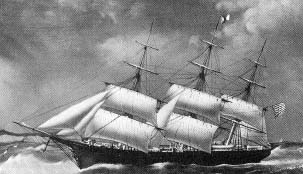 |
| Artist's depiction of Athena |
Ship:Athena
Size: 1058 tons: 167' x 36' x 23'
Built: 1857 by George Thomas at Quincy, Massachusetts
Flying a German flag, the Yankee-built Athena on 21 April 1862 began one of the most unpleasant voyages in the annals of Mormon migration. This square-rigger sailed from Hamburg with 484 Scandinavian Saints under the leadership of Ola N. Liljenquist, a Swedish master tailor and one-time burgher of Copenhagen. Elder Liljenquist was the first Scandinavian convert to return to his native land as a missionary. A strong spiritual leader, he served two missions in Europe, one as president of the Scandinavian Mission. Later he was ordained a patriarch in the LDS Church and became an early settler in northern Utah. After arriving at Hamburg from Copenhagen, the Saints traveled five miles up the Elbe River to board the Athena. Master and part-owner of the ship was Captain D. Schilling, who early demonstrated a harsh and hostile attitude toward his passengers. To his dismay, Elder Liljenquist soon learned the difference between the German and British laws in providing for emigrants during passage. He recalled, "The water for use on shipboard taken in on the Hamburg Elbe, rotted long before we reached our destination; the provisions were of very inferior kind and the way it was cooked was still worse, and then not half enough of it."
When the Mormons protested, Captain Schilling reminded them that he had carried emigrants across the Atlantic for twenty-five years and that his was the sole authority on the water. To emphasize his point, he produced the irons and handcuffs he used on passengers who did not follow his orders and persisted in complaining. Elder Liljenquist wrote in his journal:
"One Sunday afternoon, after we had concluded our afternoon services, I suppose through jealousy and not having any influence with the Saints, he threatened to throw me overboard and I suppose he would have carried out his purpose had he dared to."
The Athena steered a course north of Scotland. The weather was fair, and soon the ship was in the Atlantic Ocean. Liljenquist wrote:
"We had favorable winds for several days, with considerable motion of the sea, and therefore many suffered with sea sickness. Two weeks after leaving Glilckstadt we had covered about half the distance to New York, but from that time the wheel of fortune rather turned against us. While we hitherto had been favored with good winds, these now turned, and then at other times we had a perfect calm. The captain steered towards the southwest until we reached the Gulf Stream, about 300 miles south of the New Foundland Banks. After that we had such a calm for a whole week that not even a feather stirred and the temperature of the water and air varied between 70 and 80 degrees Fahrenheit. This sudden change from the cool north, together with the bad water, which became stagnant from the heat, caused the sickness, which already had a hold among us, to increase rapidly. The measles took away 33 of the little ones, and several of the adults also suffered with bowel complaints and diarrhea. The first winds that blew the captain utilized to take us further north into a cooler climate. Now, we are well, thanks to Him, who holds our destiny in his hands. Five adults have died, namely Ole Nielsen, 37 years old; Christine Poulsen, 29 years old; Hans Nielsen from Amager, 52 years old; Ane Nielsen, 70 years old, and Kaisa Rosen, 65 years; of age. The captain ordered the cook to make oat meal porridge for the sick in the morning, rice at noon, and sago porridge in the afternoon."
After a forty-seven-day passage the Athena arrived at New York on 7 June. Thirty-eight passengers had died, one of the highest death tolls of any emigrant company. Many others had taken ill. Two days later the company was on a train headed for Florence, Nebraska. There the Saints encountered a long delay before continuing their westward journey, and several more died.
Although built in America, this vessel's name is also recorded as Athenia either by mistake or prior to a change in registration. The ship was sold to owners in Bremen, Germany-probably because of the Civil War. She seems to have had a long service until at least 1875, but her eventual end is unknown.
Autobiography of Ola Nilsson Liljenquist
as contained in Tullidge’s Quarterly Magazine 4:1 (July 1881) pp.572-73.
April 21st, 1862, I left Copenhagen the second time, for Zion, in charge of a company of Saints, numbering four hundred and eighty-four souls. This was the fourth and last company that started from Copenhagen to Zion in the spring of 1862. I left, feeling exceedingly grateful for the power and graces that had been bestowed upon us while we had been bearing our testimonies to tens of thousands of people and felt that our garments would be unspotted from their blood in the great day of judgment. The Lord has blessed our feeble efforts with much fruit, but we felt that the harvest would be great though the laborers few. The company [p.572] arrived at Hamburg on the 22nd, and were taken by boat five miles up the Elbe, where we embarked on a German emigrant ship, a large sailing vessel, called the Athenia. We set sail on the morning of the 24th. We learned before we reached New York, to our sorrow, the difference of the German laws and the English in fitting out an emigrant ship for its long voyage. In the first place, the water for use on shipboard, taken in on the Hamburg Elbe, rotted long before we reached our destination; the provisions were of a very inferior kind, and the way it was cooked was still worse, and then not half enough of it as it was. The captain said he carried emigrants across the Atlantic twenty-six. He showed me the irons and hand-cuffs he used to put upon the emigrants when they were not servient of his will, and stated that he use to cut off the finest head of hair from the girls, and said he would treat us the same if we did not honor him as the sole chief, and quit finding fault with the treatment we had. One Sunday afternoon, after we had concluded our religious services, I suppose through jealousy and for not having any influence with the Saints, he threatened to throw me overboard, and I suppose would have carried out his purpose in a crazy fit, had he dared to. Measles broke out among us and thirty-five deaths occurred, as the result of bad water and food. Finally, after seven weeks at sea, we arrived at New York, where we took the car for St. Joseph, and from there by steamer to Florence. Horace S. Eldredge was the emigration agent at New York and he arranged everything well for us. At Florence we had a very long delay, and several deaths occurred. The four companies were made into two at Florence, C. A. Madsen was appointed captain of one, and myself of the other; and our great chief, John Van Cott, presided over both, as we traveled close together. We arrived safely at Salt Lake City, September 22nd, 1862. . . . [p.573]
A Compilation of General Voyage Notes
From Mormon Migration
"EMIGRATION NEWS FROM SCANDINAVIA. . . . the Athenia, (Captain Schilling,) on the 21st, with 484 souls, under the presidency of Elder O. N. Liljenquist. . . ."
MS, 24:18 (May 3, 1862), p.283
"Mon. 21. [Apr 1862] -- The ship Athenia sailed from Hamburg, Germany, with 484 Scandinavian Saints, under the direction of Ola N. Liljenquist. The company arrived at
New York June 6th and at Florence [Nebraska] June 19th."
CC, p.67
". . . For several months, the preparation for this large emigration had been going on in the different conferences throughout Denmark, Sweden and Norway. The emigrating Saints from the Jutland Conferences in Denmark went direct to Hamburg, while most of those from the other conferences first gathered in Copenhagen and thence made their way to Hamburg in different companies. . . .
. . . The steamer 'Albion' sailed from Copenhagen April 14, 1862, with about 500 emigrating Saints on board, and, after a successful voyage, arrived at Kiel at 8 o'clock a.m. of April 15th. After spending about two hours in transferring the baggage of the emigrants to the railway cars, the company left Kiel on an extra train for Altona, where they arrived at 1:30 p.m. President John Van Cott, assisted by other brethren, proceeded immediately to read the list of the emigrants and bring them on board the ships 'Electric' and 'Athenia' which, like the 'Humbolt' and 'Franklin,' were anchored in the Elbe off Hamburg.
The last of the Latter-day Saint Scandinavian emigrants of that season sailed from Copenhagen, April 17, 1862, on board the steamer 'Aurora,' which arrived at Kiel in the morning of the 18th and later the same day continued the journey by rail to Altona, where the emigrants spent a few hours attending to their baggage, and were then taken by a tender to the ship 'Athenia,' which lay at anchor down the Elbe near Gluckstadt. . . .
. . . On Monday, April 21, 1862, the ship 'Athenia' (Captain D. Schilling) sailed from Hamburg with 484 emigrating Saints on board in charge of Elder Ola N. Liljenquist, and before noon the ship was on the broad face of the North Sea. . . .
. . . On the 7th of June, the 'Athenia' arrived in New York, where Elder Soren Christoffersen's company was met, it having arrived the day before. Both companies left New York June 9th by train for Florence, where they arrived safely on the 19th.
The emigrants who sailed across the Atlantic in the four ships mentioned [THE Humboldt, Franklin, Electric, and Athenia] came together in Florence from which place those who had not the means wherewith to equip themselves for the journey across the plains were assisted by the teams sent there from the Valley by the Church, while those who had means wherewith to help themselves were organized into two independent companies. One of these was placed in charge of Elder Christian A. Madsen and was composed of 264 persons, 40 wagons, 14 horses, 174 oxen, 99 cows, 37 heifers, 7 calves, 6 dogs and 10 chickens, and brought along 22 tents, 32 cooking stoves, 5 revolvers and 37 rifles. Hans C. Hansen was captain of the guard and Jens C. A. Weibye secretary for the company, which was divided into six divisions with the following brethren as captains: Soren Larsen, Jens C. A. Weibye, Niels Mortensen (Lynge), Thomas Lund, Lauritz Larsen and Christian H. Gron. The first mentioned had charge of five horse teams and the others eight ox teams each.
The other company, which also counted about 40 wagons, with its quota of persons, animals, etc., was in charge of Elder Ola N. Liljenquist, and Elder John Van Cott was placed as general leader of both companies, which broke camp at Florence, July 14, 1862. The first few days some difficulty was experienced, as the oxen, who were not used to Scandinavian orders and management, would often follow their own inclination to leave the road and run away with the wagons, but after some practice on the part of their inexperienced teamsters, the difficulty somewhat disappeared. The journey from Florence was via Elkhorn River, Loup Fork, Wood River, Willow Lake, Rattlesnake Creek, Fort Laramie, Upper Platte Bridge, Devil's Gate, South Pass, Green River, etc., to Salt Lake City, where the company safely arrived Sept. 23, 1862. . . ."
HSM, pp.166-67
Reminiscences and diary of Martin Peterson Kuhre
Kuhre, Martin Petersen. Reminiscences and diary, (typescript), pp. 41-45,48. (HDA)
At one o’clock we sailed with the steamer “Aurora.” We had a pleasant voyage and arrived at Kiel the 18th in the morning at six o’clock. We came to the railroad and arrived at Altona. It took four hours, it is 14 miles. We stayed there seven hours. Was transported aboard in a little or coast [UNCLEAR] together with our baggage and was towed out to the large emigrant ship. We came aboard in the evening and got bunk together with Sister Karen and came to house. I was glad and happy because the Lord had [p.40] blessed me with a good wife to whom I could present my love and assistance. She was able to comfort and make sweet unto me life with her sincere heavenly love.
April 1862
19th. We fixed our baggage
20th. The Sabbath. We had meeting aboard. District Presidents were appointed and I was appointed as overseer over the lanterns. My beloved wife and I rejoiced together.
21st. We were still in harbor at Gluckstad. We had meeting.
22nd. Changed a dollar and brought bread and some things.
23rd. We were still in harbor at Gluckstad on account of contrary winds.
24th. The same.
25th. Hoisted anchor in the morning with good wind and stood out. We were tugged out in the forenoon. My beloved wife was taken seasick and had to go to bed.
26th. Good wind. My beloved wife kept a bed all day and was sick.
27th. Sabbath. Calm all day. Meeting on the deck. My wife was up and enjoyed the sea.
28th. Good wind and rough.
29th. Good wind. Everything well aboard. We got in sight of Scotland in the afternoon. Passed [-] lighthouse in the evening and [-] islands at 12 o’clock at night.
30th. Heavy sea with contrary wind further on in the day. Pretty much all were seasick. My wife was very sick. Laid in bed all day.
May 1862
The first of May. The same kind of weather. My wife was very sick and had to keep in bed all day. Thanks to the Lord that I am strengthened and am able to help her.
2nd. Same wind, but could manage to steer over high seas. It blew terribly. We sailed with reef sails. My beloved wife was very sick. Between 4 and 5 in the afternoon she said that now she did not feel like she could live any longer. Her pulse beat fast and seemingly death was painted in her face. I pressed her to my bosom and pressed a kiss upon her ice cold lips and my heart bled with the thought of losing her, the dearest I had in the world. She expressed what was the desire of her heart. "My Father let me live to remain with him. I love him dearly." I sprang out of bed. Her pulse was stopped. I took some wine and water and got her to drink it and it seemed she felt a little easier about the heart. The Lord heard the silent prayers of our hearts and spared her life, thanks to His name eternally. She is all the time very weak and cannot retain anything on her stomach. The most of the Saints are very sick.
3rd. We are steering the course. It is blowing almost a storm. We are sailing with bram sail. We have seen other ships with reefed sails. My wife is yet very sick. Oh, Lord, assist her and spare her life and bring us to Zion.
4th. Sabbath. Good wind and we are steering our course. My beloved wife had to keep her bed.
5th. My wife was up and was on half deck. Found herself pretty well. It was almost a storm but we went with [-]. In the afternoon we went with a side wind and we came very far towards the north. [p.41]
6th. Wind full towards the north till pretty near the evening. It blew hard and we made pretty good speed. My wife better, thanks to the Lord.
7th. About the same kind of wind and the ship went with the waves at a good speed. It blew hard.
8th. It blew hard. We went along and several ships were passed that sailed with reefed sails. My wife was lying all day. In the evening we reefed sail.
9th. Almost a storm. Meeting aboard. Hans Anderson and I administered and blessed a child who died half an hour after meeting. It was Jens Mats child, a boy. My wife well. I got a pair of dried bacon for Trine. It tasted splendid. Thanks be to the Lord for it. Rain and sharp wind from the west.
10th. My wife was up. Wind was west/southwest.
11th. Splendid weather. We were steering and we had a good meeting of the Saints on deck on quilts and blankets. I preached, requested by our President Brother Liljenquist. I felt blessed. Brother Anderson, H. P. Moller and Liljenquist preached. We did not get the meeting dismissed as the wind increased and as waves grew high and frightened some of the weakest of the Saints into gathering their clothes together. I talked with Trine and was lying on the bed clothes on deck and we talked over where we should ship in the evening. I went up to the brethren and thence down to my bed. They had to set out bram sail and store sail. The kaiver sail was broken during the night. We continued and sailed south/southwesterly. My wife kept in bed. Oh, my Lord, strengthen her both spiritually and bodily.
13th. Calm. My wife was up and better. I got a pan and fried bacon again. The steward of the ship gave it to me, God bless him for it. It tasted splendidly in the circumstances in which we were in.
14th. Easterly wind. Tail sail out. My wife was better and up, the Lord be thanked.
15th. Contrary wind. Good weather. My wife on deck in bed clothes. Considerable sickness on board. One man died. 17 (or 27) years old. A child also, 7 years old. In the evening I was up to see them sink in their watery grave.
16th. My wife also up. I was washing. The steward gave me peas for dinner. They tasted splendidly. Otherwise we should have had rotten cabbage. He gave me also some potatoes for evening and a big piece of pork of which I fried some for supper. A child died.
17th. Contrary winds and sharp. Almost a storm. My beloved wife well. I got some cod fish from the cook in the evening. The Lord bless him for his goodness towards us.
18th. The Sabbath. An old lady died during the night. Westerly wind and foggy air. Two children [-]. [THE WORD MISSING HERE IS PROBABLY, died]
19th. One child died during the night. A man died. Calm and warm and many sick. My beloved wife well.
20th. Calm and warm. The guard was angry with Brother Halmstead. [POSSIBLY Holmstead] Brother Halmstead asked his pardon. In the evening there was music and dancing on the half deck. Most of them participated in the dance even though their wives and everything that would keep them there was about dead. I and my wife were lookers on to all this.
21st. Still calm and warm. A child died. [p.42]
22nd. A sharp wind. A woman and a boy 16 years old dies and a child. My beloved wife was seasick. Oh Lord, assist her.
23rd. A child died last night. Calm in the forenoon. Storm in the afternoon and good wind. This man has lost three children, Carl John Mork. [POSSIBLY, Mark]
24th. Four children died last night. Jens Poulson's [Poulsen] two sisters and wife and a child died. My beloved wife is not well today. Oh Lord, restore her I ask Thee in the name of thy beloved son, Jesus Christ, and bring us to Zion for thy mercy's sake. The wind calm today. Last night, rain, thunder and lightning. My beloved wife very sick of diarrhea. We got some wine soup from the captain. It strengthened her very much.
25th. My dear wife has been very sick during the night. Brother Moller's boy brought us a sugar dipped in opium from the captain to ease it. The wind northeast and sharp breeze. One child died during the night. My wife got a cup full of something that Brother Nielsen called liquor. Something unpleasant to drink but I hope it will help her. My beloved wife is still very sick. I got some pancakes for her from the cook. She ate a little of them.
26th. Two children died. The wind calm. My wife better. She got some warm wine and it did her good. In the afternoon she was worse. We brought the midwife and asked her assistance.
27th. My wife was very sick. Oh, Lord, assist her. The midwife counseled to bleed her which was done twice on one arm but did not get any blood. Niels Johansen brought blood from the other arm. The wind easterly and a slow breeze.
28th. My dear wife very sick. I am downcast, but my hope is to the Lord that He will raise her and turn her sufferings into joy in the coming days. She cannot retain food and is all the time writhing and in pain. A woman died today. Good wind, the Lord be thanked, but almost a storm. Four bram sail blown to pieces. The ship is going at the rate of 11 1/2 miles in four hours. The wind went west and the mar sails reefed for the first time on the voyage. High seas and the ship working heavily.
29th. My beloved wife a little better but she can still take nothing of such as I can get her to strengthen the weak body. I fried a few potatoes for her. She ate a few of them. Oh, my God, spare her life. Hear or hear thy humble servant's prayer for the dearest which thou hast given me on earth. The wind blew considerably, but we had lots of sail up.
30th. My beloved wife was a little better; a little. The wind was westerly. Four children died today.
31st. Calm. My dear wife was a little better today, thanks to the name of the Lord eternally.
June 1862
The first of June, the Sabbath. The wind south and calm. Was together with a ship from Bremmen by the name of “Helena.” Our captain visited them and they visited us. My beloved wife better today but must all the time keep in bed. I cooked a little chicken broth for her today from the table of the captain. She had wished it so long and she enjoyed it so well, thanks to the Lord as we have to acknowledge His hand in all things. Meeting on deck. Brother Liljenquist preached and we had a blessed day and fine weather. A child died during the night.
2nd. Foggy weather. A girl died today. My dear wife is better day by day. I got a little food for her from the captain's table. It strengthened her bodily. [p.43]
3rd. The same foggy weather and calm. Everything well aboard except a little sickness but not so bad as has been. There happened a little between my dear wife and myself on account that we did not always deal as wisely as we ought. We got it settled but not without tears on both sides. The Lord give us mercy to deal more according to wisdom as we do love one another so sincerely.
4th. Foggy. We passed two steamers. We had good wind all the time but foggy weather. My dear wife better every day. Two children died today.
5th. My dear wife very sick. The ship rocked very much and is sailing with a good wind and all of us waiting to see land. I got a little chicken soup from the Captain's table to my beloved Trine. About 3 o'clock in the afternoon we got land in sight. Blessed feelings passed through my soul when I saw the land which is the object of my desires and future hopes. The land where I was to pass through sorrow and joy and whatever comes in life together with this beloved woman the Lord has given me. Oh my hope is for time and eternity in this land where thousands are flocking to prepare for the millennial morning. Oh, Lord, hear Thy humble servant's prayer and strengthen and raise my beloved wife.
6th. [-] and cast anchor at 8 o’clock. We heaved anchor again and sailed up a splendid river and enjoyed ourselves seeing the beautiful forests and landscapes. My beloved wife was up and rejoiced in union with me. We passed the doctor and got permission to go right up to New York. We arrived in the city at 5 in the afternoon. One child died. We soon got a little to eat and refreshed ourselves. In the evening a dance on deck.
7th. Two children died today; in all 39. We arrived at Castle Garden and was glad and rejoiced. We went up and had warm beef. It did us good after a long voyage. We went to a hotel and took a nights lodging there.
 |
| Castle Garden Emigrant Depot, New York (circa 1855) |
8th. Day of Pentecost. We went around and got us something to eat and looked around a little.
9th. We came to Castle Garden from the hotel. Two women had two births during the night in Castle Garden. We drove from Castle Garden at six in the afternoon to the station in wagons. We traveled from New York at half past eight in the evening and arrived at Albany at 6:30 in the morning.
10th. After we had rejoiced very much in seeing this pleasant land, these romantic rocky mountains, the green splendid forests and the fruitful fields; my beloved wife was pretty well satisfied. We traveled from Albany at 12:30 noon and arrived at Niagara at 11:30 noon on the llth, and rode over the bridge under which the great Niagara water fall is running. We camped in a green space and ate and drank and looked at this so much spoken of waterfall with great interest. We left Niagara at 2:30 afternoon and arrived the 12th in the morning at 7:00 at Windsor where we were set over to Detroit by a steamer. Traveled further at 2 in the afternoon. A child died in the car where I was.
13th. A boy of ten years fell out of the car and got his toes of one foot crushed. We arrived at Chicago at one in the afternoon. Everything well. We had splendid cars to ride in. We left Chicago at 5 in the afternoon and arrived the 14th at Quincy at 2 in the afternoon. Went aboard in the steamer and sailed along the Mississippi River 20 miles to Hannibal where we lodged in the cars over night. [p.44]
15th. Sabbath. We remain in Hannibal. Bought meat and made soup in the fields.
16th. We left Hannibal at 5 in the morning and arrived at St. Joseph at 6 in the afternoon. Camped on a green plain. A little after midnight we went aboard on a steamer and left St. Joseph the same night.
17th. We sailed up the Missouri River. Sister Sophis [Sophie] Olsen died today aboard the steamer about 6 in the afternoon.
18th. A child died today. We landed in Florence at 12 midnight.
19th. We hauled our baggage to the camping place and camped there.
20th. Attended to necessaries together with my dear wife.
21st. I made out a note to Brother Niels Johansen calling for 132 dollars American money at 4% interest annually until the same shall be paid.
22nd. Sabbath. Meeting under open heaven. I was not there on account of not feeling well. I built a bower to protect us from the heat of sun.
23rd. Very damp. My beloved wife not well. I bought an oxen for thirteen dollars.
24th. Heavy thunder during the night. The day passed attending to the necessities.
25th. The same.
26th. I went out in country a little together with brethren in order to buy cows. We went 9 ½ (or 4 ½) miles to town by name Gallawan. We were lying there overnight but went further again in the morning of the 27th without getting any cows. I bought a good cow on my road home for 20 dollars. I came home about noon. This day was my dear wife’s birthday, 24 years old.
28th. I was looking out for the cow and was looking after the necessities together with my dear wife.
29th. Sabbath.
30th. We received our oxen.
July 1862
The first of July. I herded our oxen and our cow. I was not satisfied with our oxen and gave the brethren to understand it and they thence told me I could have my money back if I desired it. I concluded that I myself would get my wagon.
2nd. I went to Omaha in the morning and looked at some wagons but returned without buying any.
3rd. I bought the one pair of oxen from the brethren and had to give $69.75 for them. I went out and looked at a cow but went back again without buying it.
4th. The jubilee of the Americans.
5th. I and my wife went out and got a cow and gave $15 for it.
6th. Sabbath. We wrote some in a letter home to Denmark and herded our stock.
7th. Nothing remarkable.
8th. Very strong thunder and two English brethren were killed by the lightning.
9th. Rain and we almost swam in water in the tents. I bought a wagon for $50.
10th. I set [-] on the wagon and sent the wagon to the smith’s and brought provisions.
11th. I bought some provisions and fixed for the journey . . . . [p.45]
. . . [Sept.] 26th. We reached Salt Lake City....[p.48]
BIB: Kuhre, Martin Petersen. Rem
Sources:
1. Ancestry.com. New York Passenger Lists, 1820-1957 [database on-line]. Provo, UT, USA: Ancestry.com Operations, Inc., 2010. Passenger Lists of Vessels Arriving at New York, New York, 1820-1897; (National Archives Microfilm Publication M237, 675 rolls); Records of the U.S. Customs Service, Record Group 36; National Archives, Washington, D.C. Year: 1862; Arrival: New York, United States; Microfilm Serial: M237; Microfilm Roll: M237_220; List Number: 521.
2. Ancestry.com. New York Passenger Lists, 1820-1957 [database on-line]. Provo, UT, USA: Ancestry.com Operations, Inc., 2010. Passenger Lists of Vessels Arriving at New York, New York, 1820-1897; (National Archives Microfilm Publication M237, 675 rolls); Records of the U.S. Customs Service, Record Group 36; National Archives, Washington, D.C. Year: 1862; Arrival: New York, United States; Microfilm Serial: M237; Microfilm Roll: M237_220; Line: 12; List Number: 521.
Wednesday, September 26, 2012


Monday, September 24, 2012
John Hansen Property in California
According to the memory of Wayne Bingham, John Hansen's grandson, John went to California to purchases a piece of property for a retirement home away from the severe Idaho winters. In 1918 John took the train from Idaho Falls to Madera, California to get things started. The train took him from Idaho Falls down to Ogden, Utah and then across norther Nevada into Sacramento and then down to Winton, California. The property in Winton was 20 acres on which John planned to raise fruit trees. The current address of the property is 6641 Mercedes Ave, Winton, California. After John's death in 1921 the property was let go by Alice Hansen to cover outstanding taxes and other fees on the property.
+-+USGS+Map+of+Winton,+California+with+Property+Highlighted.jpg) |
| Property Owned by John Hansen (Shown in green north) Overlaid on the 1917 USGS Map of Winton, California Area |
+-+California+Property+Photo.png) |
| View of the property from the road looking south west |
+-+California+Property+Photo+2.png) |
| Another view of the house and garage |
+-+Merced+County+Assessor's+Parcel+Map+Lot+%2336-37.jpg) |
| Merced County Assessor's Parcel Map from 1976 showing details of property once owned by John Hansen (Lot #36 and #37) |
Alice Elizabeth Bateman Hansen's Actual Birth Date
Alice Elizabeth Bateman Hansen and her family seemed to believe she was born on 29 August 18681 in Stifford, Essex, England. Alice's son, Lawrence Hansen, who is listed as the informant on her death certificate also listed 29 August 1868 as her birth date and location. Further research has uncovered her date of birth as most likely 18 July 18672 based on birth records located in England for Orsett registration district and Grays subdistrict. The information for this record was provided by Alice's mother, Ester Wiffin Bateman, who was most likely present for the birth. The birth information was recorded on 28 August 1876 in Stifford.
Stifford is located along the northern banks of the Thames River about 22 miles east of downtown London and is now broken into North Stifford and South Stifford. Additional information on Stifford, England can be located at http://www.northstiffordvillage.co.uk/index.html.
Source:
+-+Birth+Certificate.jpg) |
| Birth Record for Alice Elizabeth Bateman (1867) |
+-+Death+Certificate.jpg) |
| Death Certificate for Alice Elizabeth Bateman Hansen (1961) |
Stifford is located along the northern banks of the Thames River about 22 miles east of downtown London and is now broken into North Stifford and South Stifford. Additional information on Stifford, England can be located at http://www.northstiffordvillage.co.uk/index.html.
 |
| Stifford Parish Church |
Source:
1. Idaho Department of Health and Welfare, death certificate no. 972, Alice Elizabeth Hansen (1961), Division of Vital Statistics, Boise.
2. England. Registrar General. Birth Certificates. General Registry Office, South Port., England, birth certificate (short form) for Alice Elizabeth Bateman, born 18 July 1867; citing entry 243, Orsett registration district and Grays subdistrict; General Registry Office, Southport.
Subscribe to:
Posts (Atom)